Klara Peters · 8 October 2026
Adapting Data Pipeline Architectures to Support Evolving Compliance Requirements in Distributed Web Services
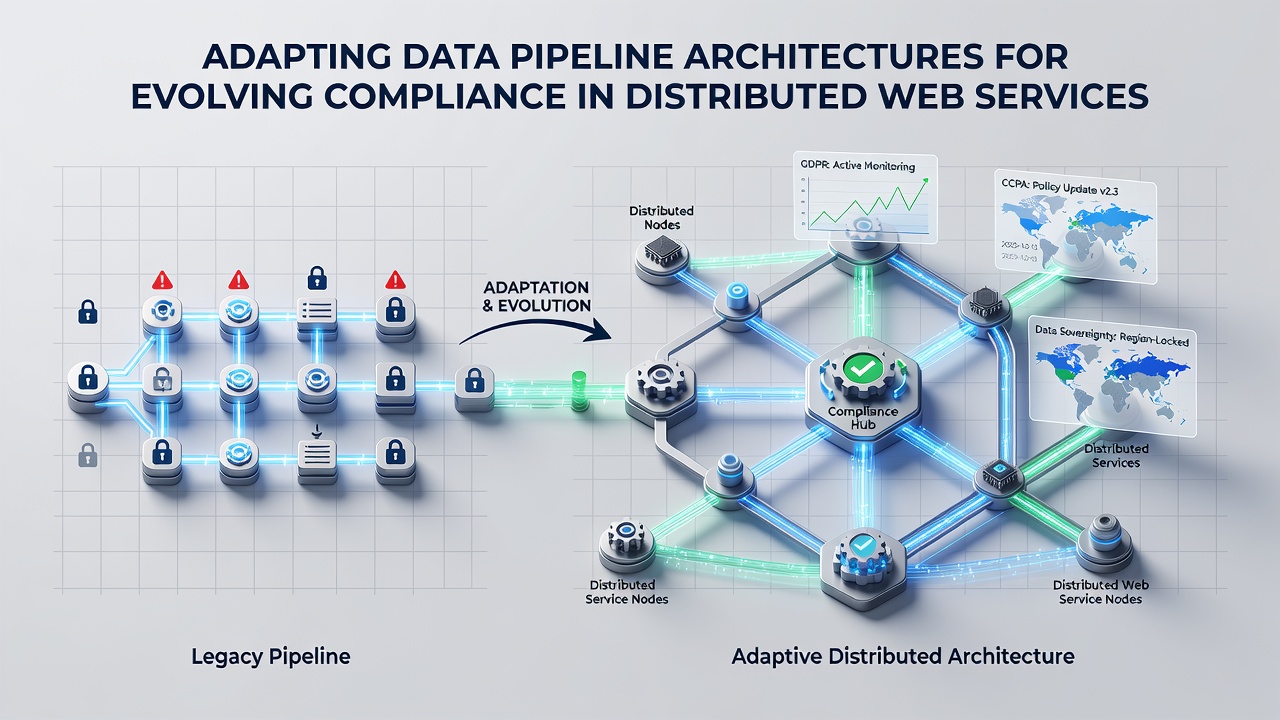
Distributed web services generate continuous streams of user data across multiple geographic regions, and organizations must modify their data pipelines to accommodate shifting regulatory frameworks without interrupting service delivery. These pipelines typically incorporate ingestion layers, transformation engines, storage systems, and analytics endpoints, each of which requires targeted updates when new rules emerge around data residency, consent management, or audit logging. Researchers tracking compliance trends note that updates to frameworks such as the General Data Protection Regulation and the California Consumer Privacy Act have prompted many engineering teams to introduce modular components that allow policy changes to propagate through existing flows rather than requiring complete rebuilds.
Key Drivers of Regulatory Change in Data Handling
Multiple jurisdictions have introduced or revised data protection statutes over the past several years, and October 2026 marks the scheduled implementation date for several amendments that emphasize enhanced cross-border transfer mechanisms along with stricter requirements for automated decision-making transparency. Observers at regulatory bodies report that these updates often focus on mandatory encryption standards for data in transit and at rest, as well as expanded rights for individuals to request deletion across all replicas in a distributed environment. Teams responsible for web service infrastructure therefore examine how their current architectures support dynamic policy enforcement, because static configurations frequently fail to meet the documentation and reporting obligations that accompany these revisions.
Industry reports from sources such as the European Commission indicate that organizations operating global web platforms encounter overlapping obligations when data crosses national boundaries, which necessitates pipeline designs capable of applying jurisdiction-specific rules at ingestion time. Data indicates that failure to adapt early leads to increased latency during compliance audits, since manual reconciliation processes cannot scale with the volume generated by distributed services.
Architectural Patterns for Flexible Compliance
Engineers have shifted toward event-driven designs that embed compliance validators as independent microservices, allowing updates to legal requirements to occur through configuration files rather than code deployments. Such patterns separate the core data transformation logic from the rules engine that checks consent status, retention periods, and access controls, and this separation enables teams to test new regulatory scenarios in isolated environments before rolling them out across production clusters. Studies from academic institutions show that pipelines built with schema registries and versioned data contracts reduce the risk of non-compliant records propagating downstream, because each transformation step validates incoming payloads against current policy definitions.
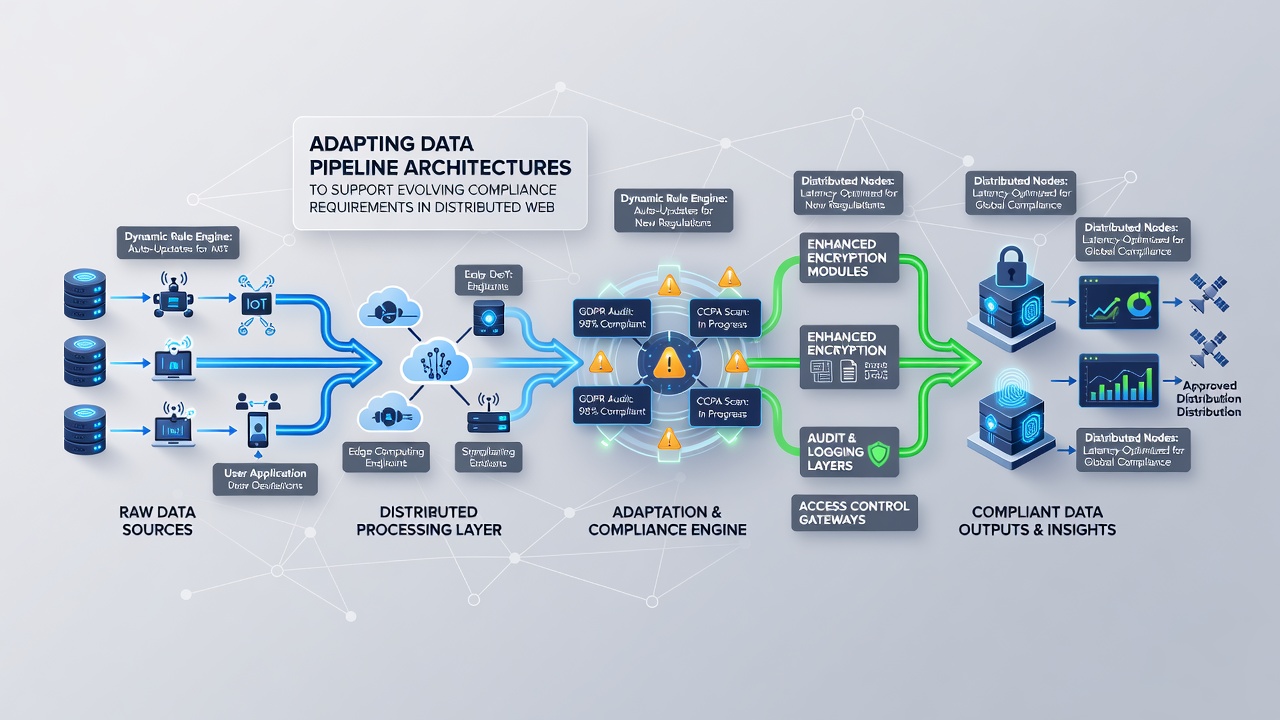
Real-time monitoring layers have become standard additions, and these layers track metrics such as data lineage completeness and encryption status across every node in the service mesh. When a new requirement surfaces, operators can adjust thresholds in the monitoring system without halting data movement, which maintains service availability while satisfying audit demands. The National Institute of Standards and Technology framework outlines reference architectures that incorporate these monitoring elements, and organizations that follow similar blueprints report smoother transitions during regulatory updates because their systems already expose standardized interfaces for compliance reporting.
Implementation Challenges and Mitigation Strategies
One challenge arises when legacy storage systems lack native support for granular deletion requests that span multiple replicas, yet distributed web services often rely on such systems for cost efficiency. Teams address this by introducing intermediary caching layers that maintain compliance metadata alongside the primary records, allowing deletion commands to execute through coordinated workflows rather than direct database operations. Evidence from case studies reveals that this approach lowers the operational burden during peak compliance periods, although it requires careful capacity planning to avoid bottlenecks in high-throughput environments.
Another consideration involves maintaining consistent audit trails when data transformations occur across geographically dispersed compute nodes, and solutions frequently include immutable log stores that timestamp every policy evaluation. These stores integrate with existing pipeline orchestration tools so that compliance events become part of the same stream used for business analytics, which simplifies downstream reporting without duplicating infrastructure.
Conclusion
Organizations continue to refine their data pipeline architectures to align with regulatory developments that affect distributed web services, and the patterns emerging in 2026 emphasize modularity, real-time validation, and integrated monitoring. By embedding compliance logic at multiple stages and leveraging configuration-driven updates, engineering teams achieve the flexibility needed to respond to new requirements while preserving performance and reliability across global deployments.